Don’t trust AI.
Verify it.
SAIF SR runs your systematic review with AI and hands you the statistics proving it was done right. Screening, extraction, and blinded human verification, ending in numbers a journal will accept.
Rigor shouldn’t cost a year of reading.
And it still doesn’t tell you what you missed.
| The traditional way | With SAIF SR | |
|---|---|---|
| Screening burden | Traditional: 20,000 human decisions for 10,000 abstracts: every record, read twice. | SAIF SR: Your reviewers screen a blinded statistical sample, sized by the confidence you want, not the size of your corpus. |
| Time in screening | Traditional: Months of reviewer hours, calibration meetings, chasing stragglers. | SAIF SR: Days for the full pass; scheduled batches for your reviewers. |
| Error rate | Traditional: Unknown. Disagreements get resolved, not measured. | SAIF SR: Recall estimated with a 95% confidence interval from blinded verification. |
| Reproducibility | Traditional: Final labels survive; the reasoning behind them doesn't. | SAIF SR: Every decision logged with its rationale, replayable end to end. |
| Your methods section | Traditional: “Two reviewers screened independently.” A sentence, not evidence. | SAIF SR: Sampling design, agreement statistics, performance bounds. Reportable as written. |
Verified sampling replaces the second full human pass. The work drops by an order of magnitude, and unlike the traditional way, you can quantify what it missed.
The stages you already run, with verification built in
You bring your search results, your criteria, and your reviewers. Every stage keeps the dual-review structure you’d defend to a methods editor (screening, adjudication, extraction), with the reading done for you.
Set up your review
Upload your search results and define your protocol: inclusion and exclusion criteria, the data fields to extract, and who your reviewers are. We deduplicate, pull abstracts and open-access full texts, and flag the PDFs you'll need to upload yourself.
Title & abstract screening
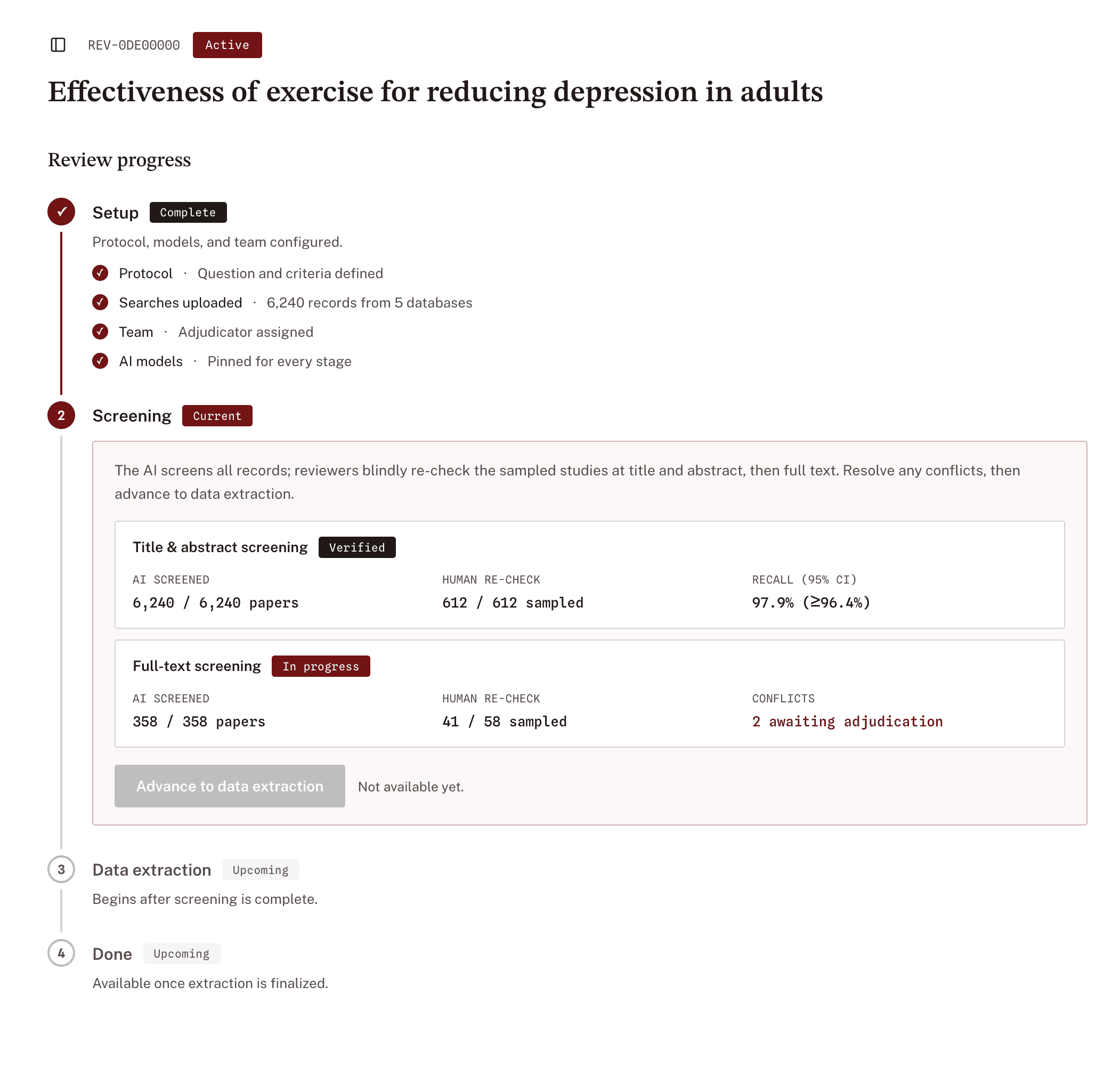
Every record is screened against your criteria in days, not months. Your reviewers screen batches exactly as they would in any dual-review protocol (a sample sized to prove nothing relevant slipped through), and a third reviewer settles conflicts.
Full-text screening
The same protocol at full text: every eligible paper checked against your criteria, your team verifying its share, exclusion reasons recorded for your PRISMA diagram.
Data extraction
Your fields, extracted from every included study, each value linked to the passage it came from. Reviewers verify samples per field, so you know exactly which numbers you can trust.
Your report
PRISMA flow, included-studies table, extraction dataset, and a verification report with recall bounded at 95% confidence, agreement statistics, and a replayable audit trail. Ready for your methods section.
Follow one review, start to finish.
From 9,120 search results to 52 included studies. Step through the PRISMA flow to see what the AI screened, what a human verified, and why every excluded study has a reason on record.
Upload your search exports and define your protocol, once.
Bring the results from every database you searched. Set your inclusion and exclusion criteria, the fields to extract, and who your reviewers are. SAIF deduplicates, pulls abstracts and open-access full texts, and flags the PDFs you supply.
Among adults with overweight or obesity, do GLP-1 receptor agonists produce greater weight loss than placebo or lifestyle intervention alone?
- Randomized controlled trials.
- Adults 18 and older with overweight or obesity (BMI ≥ 27).
- A GLP-1 receptor agonist (e.g. semaglutide, liraglutide) as the primary intervention.
- A weight or body-composition outcome reported (e.g. % body-weight change).
- Type 1 diabetes as the study population.
- Interventions with no GLP-1 receptor agonist arm.
- Conference abstracts or protocols without full results.
- Non-English publications (screened for translation feasibility).
The report you hand reviewer 2
Every review ends in a verification report: performance bounds, human comparison, and the sampling design that produced them. This is an excerpt.
Screening recall, AI vs. human: point estimate and 95% CI
- Relevant studies missed
- ≤ 5
- 95% confidence, of ~155 estimated
- AI vs. human recall
- p = .02
- exact McNemar, paired records
- Inter-rater agreement
- κ 0.81 · AC1 0.93
- human reviewers, blinded
- Decisions in audit trail
- 24,881
- every prompt and response, verbatim
Sample data from a demonstration review, not a live result. Your report carries your review’s numbers, or it doesn’t ship.
Asked by careful people
Do my reviewers see what the AI decided?
No. Blinding is absolute until the numbers are in: reviewers work normal screening batches with no AI output, no hint of which records are part of the verification sample, and no access to interim statistics. That's what makes the comparison honest.
Which AI models can I use?
Anthropic and OpenAI models at launch, pinned to an exact version for the life of your review; performance claims name the model outright (“this model achieved this recall on this review”). If a model is at risk of deprecation before your review would finish, we say so before you pick it. Self-hosted models are on the roadmap.
What happens where the AI performs poorly?
The statistics find out before you do. If a screening step or an extraction field can't meet its performance target, that work falls back to your human reviewers, and the report says exactly what was AI-verified and what was human-done.
Who owns my review data?
You can export everything, at any time: decisions, extracted data, PRISMA counts, and the full audit trail. Your review is yours to publish, defend, and take with you.
What does it cost?
Beta pilots run free while we validate the methodology together. Pricing will be per review, sized so that it's a fraction of the student-hours it replaces. Waitlist members hear first.
The first AI you can put in your methods section.
SAIF SR is in limited beta. Join the waitlist and run your next systematic review with the receipts attached.